
Parents, Is Your Child Ready for
Board Exams?
Board exams are not only about studying for long hours.
Students need the right strategy, regular practice,
proper revision, doubt solving and confidence to perform well.
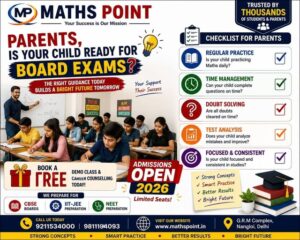
Board Exams Need More Than Just Hard Work
Board exams are an important stage in a student’s academic journey.
But simply studying for many hours does not always mean that a student
is fully prepared.
What matters is how the student studies.
Concepts should be clear, questions should be practised regularly,
doubts should be solved on time and mistakes should be reviewed.
At Maths Point, the focus is on helping students
understand concepts, practise questions and gradually build the
confidence required for examinations.
Parent’s Board Exam Preparation Checklist
Parents can regularly check these simple points to understand
whether their child is following a healthy study routine.
✓
Regular Practice
Is your child solving questions regularly instead of
studying only before the examination?
✓
Time Management
Can your child manage study time, homework, revision
and tests properly?
✓
Doubt Solving
Are doubts being cleared regularly or are difficult
questions being left for later?
✓
Regular Tests
Is your child solving tests regularly to understand
preparation and identify weak areas?
✓
Revision
Is enough time being given to revise previously
completed chapters?
✓
Mistake Analysis
After a test, does your child understand why an answer
was incorrect and how to improve it?
Common Problems Students Face Before Board Exams
1. Concepts Are Not Clear
Students sometimes try to remember formulas without
properly understanding the concept behind the question.
2. Irregular Practice
Mathematics requires regular question solving.
Long gaps between practice sessions can make topics
difficult to remember.
3. Pending Doubts
A small doubt in one chapter can create problems when
the student moves to a more advanced topic.
4. Exam Time Pressure
Students may know the answer but struggle to complete
the paper comfortably within the available time.
5. Fear of Difficult Questions
Regular exposure to different types of questions can
help students become more comfortable with unfamiliar
problems.
6. No Mistake Review
Tests become more useful when students review their
mistakes and understand how to avoid repeating them.
How Students Can Prepare Better for Board Exams
A simple and consistent approach can make board exam preparation
more organised and productive.
1
Understand the Concept First
Before solving many questions, make sure the basic
concept is understood clearly.
2
Practise Regularly
Regular practice helps students become familiar
with different types of questions.
3
Clear Doubts Quickly
Do not allow doubts to keep accumulating.
Ask questions and understand the solution.
4
Take Regular Tests
Tests provide an opportunity to practise solving
questions under examination-like conditions.
5
Analyse Mistakes
Don’t simply check the marks. Find the reason behind
every mistake and work on the weak area.
6
Revise Again and Again
Revision helps students recall important concepts,
formulas and methods when they need them.
How Parents Can Support Board Exam Preparation
Parents do not need to become teachers to support their child’s
preparation. A calm and supportive environment can make a big
difference in the daily study routine.
- Encourage a regular study schedule.
- Ask about difficult topics instead of only asking about marks.
- Make sure pending doubts are being addressed.
- Encourage regular revision and practice.
- Discuss test mistakes in a positive way.
- Give the student enough time for sleep and breaks.
- Focus on consistent improvement rather than comparing with others.
Board Exam Preparation at Maths Point
Maths Point focuses on concept clarity, regular practice,
doubt solving and examination preparation. The institute
provides coaching for school-level subjects as well as
other academic programs. :contentReference[oaicite:1]{index=1}
Concept Clarity
Regular Practice
Doubt Solving
Regular Tests
Exam Preparation
Maths Coaching for School Students
Strong mathematical concepts developed during school years can
help students approach board-level questions with greater clarity
and confidence.
Class 9
Build Strong Mathematical Foundations
Class 10
Board-Focused Preparation & Practice
Class 11
Strengthen Concepts for Higher Studies
Class 12
Board Exam Preparation & Revision
A Simple Formula for Better Preparation
Understand → Practise → Clear Doubts → Test → Analyse → Improve
Instead of waiting until the final weeks before the board
examination, students can follow this cycle throughout their
preparation. This makes studying more systematic and gives
students opportunities to identify areas that need more work.
Frequently Asked Questions About Board Exam Preparation
When should students start preparing for board exams?
Board preparation should ideally be treated as a continuous
process. Regular learning, practice and revision are more
useful than depending only on last-minute study.
Is solving questions important for Mathematics?
Yes. Understanding the concept is important, but students
also need regular question-solving practice to become
comfortable with different problems.
Why are regular tests useful?
Tests allow students to practise under time limits and
identify topics or question types that need additional
attention.
What should students do after making mistakes in a test?
Students should identify the reason for the mistake,
understand the correct method and practise similar
questions again.
Does Maths Point provide coaching in Nangloi?
Maths Point is located at GRM Complex, Nangloi, New Delhi.
Parents and students can contact the institute for current
course and admission details.
Give Your Child the Right Preparation Strategy
Strong concepts, regular practice, doubt solving and
consistent revision can help students prepare in a more
organised way for their board examinations.
📞 9211534000
📞 9811194093
Book a Free Demo
Maths Point
G.R.M. Complex, Nangloi, New Delhi
Website: www.mathspoint.in